Patient positioning is one of the biggest drivers as far as good posture or bad posture. So I'm
really glad that we're talking about that. Having a nice patient chair is crucial. One that,
yes, is comfortable for the patient, but also is designed in a way that's not going to get in our
way. And I like to say a comfortable patient is a compliant patient, right?
So we need to keep them comfortable too, but not at the expense of sacrificing our bodies.
Welcome to Austin, Texas, and welcome to the Phil Klein Dental Podcast. If you've ever ended a long
clinical day with a sore neck, tight shoulders, or a nagging backache, you're not alone.
And more importantly, it's not something you just have to accept as part of the profession. And if
you're early in your career, feeling good, moving easily, and wondering what everyone else is
complaining about, just know this. The effects of poor ergonomics don't show up all at once.
They build quietly over time. until one day they do. In this episode,
we're diving into one of the most overlooked threats to career longevity in dentistry, ergonomics.
From the subtle habits we develop over time to the way our dental chairs and operatores are
designed, small daily compromises can quietly add up to real strain,
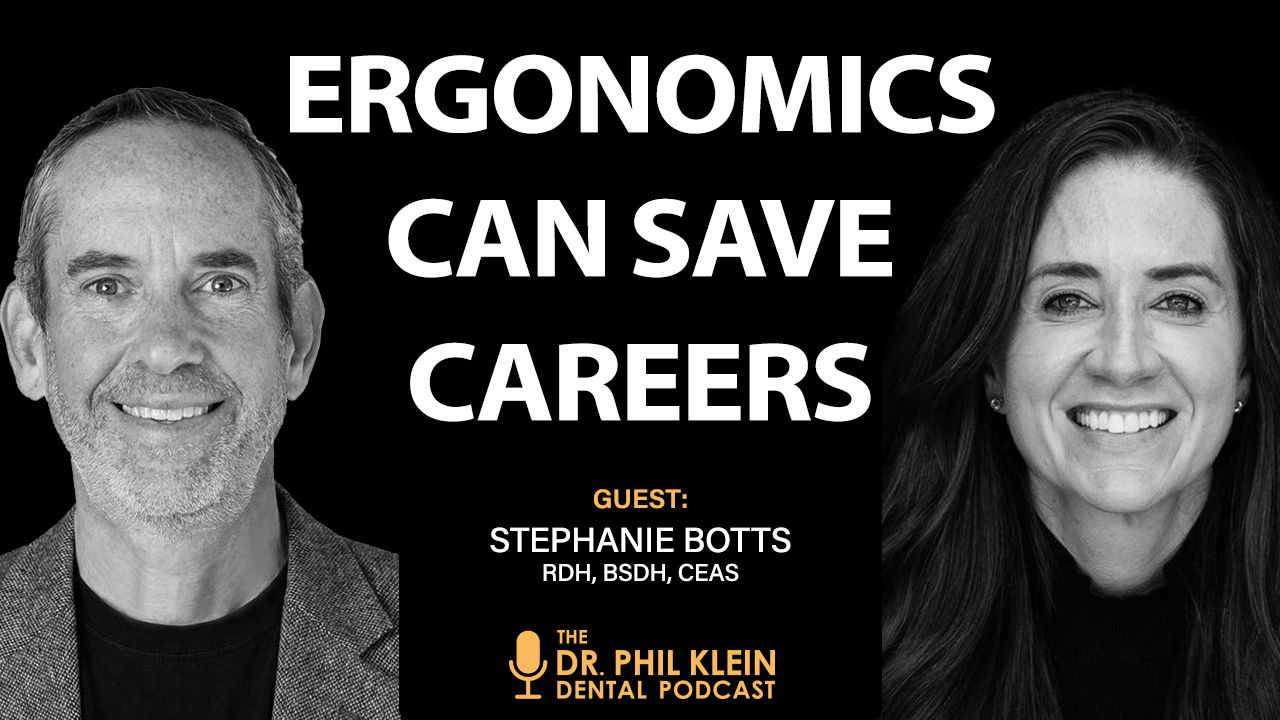
injury, and even burnout. Joining us is Stephanie Botts, a clinical dental hygienist and certified
ergonomics assessment specialist and the founder of Polished Posture. Stephanie works with dental
teams across the country, both in office and virtually, helping them reduce pain, improve posture,
and practice in a way that's actually sustainable long-term. We're going to talk about the most
common ergonomic mistakes clinicians make, how patient positioning and equipment design directly
impact your body, and most importantly, what you can start changing immediately to protect yourself
and extend your career. Because dentistry is demanding enough. Working in pain every day shouldn't
be part of the job. Before we bring in our guest, I do want to say that if you're enjoying these
episodes and want to support the show, please follow us on Apple Podcasts or Spotify. You'll be the
first to know about our new releases and our entire production team will really appreciate it.
Stephanie, it's a pleasure to have you on the show. Thank you so much, Phil, for having me back.
It's always nice to sit and chat with you for a little bit. Yeah, absolutely. And thank you very
much for an excellent presentation that you gave to Viva Learning on April 28th. I certainly
encourage all of our listeners to check it out. It's called The Top Ergonomic Mistakes in Dentistry
and How to Fix Them. Really good webinar, and thank you for that. So let's begin this episode with
just a little bit of history. Dentistry didn't exactly start with great ergonomics.
In the earliest days, patients were often treated wherever space allowed, even on the floor,
with the practitioner stabilizing the patient's head between their knees in order to get access.
It was all about extraction and survival back then. Take the tooth out, save the patient's life.
It certainly was not about posture or career longevity for sure. And then as the profession became
more formal, thanks to pioneers like Pierre Fauchard and other folks like that,
those innovators, things improved clinically, but not so much ergonomically. Dentists typically
stood and leaned over patients seated in straight back chairs, as you know, often working in poor
lighting. Long days in a hunched position were just part of the job.
toll was largely ignored. The real shift started, I think, Stephanie, with the introduction of the
dental chair in the late 1800s. That was the beginning of the reclining patient, better lighting,
and more thoughtful delivery systems, which finally allowed dentists to work with the setup rather
than working around the setup. So by the mid-20th century, we're talking 1950s,
sit-down dentistry and four-handed dentistry began to take hold. bringing a more intentional
approach to workflow and positioning. So now fast forward to today, and while our technology truly
has dramatically improved, the physical demands haven't gone away. They've just changed.
They've kind of just transformed into something different. And in many cases, procedures are
longer, more precise, and often more sedentary. And that means that the consequences of poor
ergonomics show up earlier and stick around longer. So in many ways, the dental operatory has
evolved tremendously. We all know that with all these advancements. But when it comes to how we
actually use our bodies day to day, a lot of clinicians are still paying the price physically and
in many cases, heading down a path that could ultimately shorten their careers. Do you agree with
all of that premise before we get started with some questions? Yeah, and I really appreciate that
little history lesson there, Phil, because it's really fascinating to see where we started and
where we're at now. And with all of these advancements with great equipment and loops and great
stools, pain rates are still super high, which is really interesting, right? You would think that
it wouldn't be that way. And I really love what you mentioned about standing because dentistry used
to just be 100% standing. Then we got some new equipment that allowed them to. then they
transition to mostly sitting and now at least what i recommend is a blend of the two because doing
one or the other constantly isn't great so i like it when people alternate but it's really
interesting to look back and see how far we've come but also see the issues that we still have yeah
absolutely so what are the most common musculoskeletal problems you're seeing and i assume they
involve the neck the back the shoulders and of course the wrists And generally speaking,
how early in a clinician's career do these injuries typically show up? Yeah,
I mean, you hit all the hot spots. We're still seeing a lot of carpal tunnel and wrist tendonitis.
There's a fair amount of tennis elbow where they get tendonitis in their elbow as well. Rotator
cuff injury. And of course, back issues, low back injury. That was my injury was a low back
problem. But there's all kinds of things. We could get tendonitis in the thumb. We could have hip
issues. So it all depends on the clinician. But really, on average, it can take as little as just
two years for someone to start. developing symptoms, but I hear often from students who aren't even
done with school yet they have not even taken their boards yet and they're already in pain and
they're like oh my god did i just make a huge mistake you know so depends on the clinician um and
there's a lot when we talk about ergonomics obviously i'm passionate about that but i'm also
passionate about making sure you're you're building your body you know building that strength doing
some strength training and really taking care of your body outside of the operatory as well yeah so
it's a combination of staying fit strengthening the areas in your body that absolutely apply to
your career, but also having the right setup and the right equipment, because without that,
then you're compensating all the time and you're adapting. So when you walk into a dental
operatory, what are the first red flags that tell you someone is headed toward injury?
And how can clinicians start recognizing their bad ergonomic habits in their own routines?
Part of my job that I really like is going in and it's different for every clinician. So I look at
what are they doing in their operatory? Are they a hygienist? Are they a restorative dentist
practicing four-handed dentistry? We've got operatories that are better for each of those.
And I think a mistake some offices or practice owners make is making every operatory the exact same
layout, no matter if it's used for hygiene or restorative or operative, when we really need to be
taking a more individual. individualized approach with that. But looking where their equipment is,
are they having to reach constantly for their equipment, either across their body or...
away from them. We want to limit reaching. Are they forced to twist in their operatory? Do they
have a patient chair that is like helping their posture or hurting their posture? So I really think
it's important for clinicians to at least take an introductory lesson on ergonomics,
because if we're not aware of what we're doing, like how can we fix it? Right. Same with the mouth.
If we don't know that soda is bad for our teeth, then we're not going to stop doing it. So I think
either just an introductory. course on ergonomics and then really just learning and recognizing
what they're doing and trying to address those mistakes. Yeah. And talking about addressing those
mistakes, I mean, ideally in a perfect world, you'd have an empty room, right? The dental clinician
walks into a room, there's nothing there but four walls. And they come to someone like you and they
say, Stephanie, this is what I do. I'm a dental hygienist or I'm a... dentist who does a ton of
operative dentistry, whatever it is, and then you could equip them or someone,
some expert can equip that room perfectly and they could build their body with exercises and good
regimens of workouts, whatever they need to do to build up the muscles that they're using on a
daily basis, and then be aware of what they're doing on a daily basis as far as not getting into
any bad habits. That would be the ideal situation, but that's... You know, how many times is that
going to happen, right? Because a dentist is coming in as an associate, a dentist bought an
existing practice, a dentist is hired by a DSO, and they get what they get. So when someone,
when a clinician identifies an injury that's starting to get worse, and their pain is starting to
build, and they're stuck with what they have, what should that, let's talk about a hygienist, what
should she or he do to try to fix it where the dentist says, okay, I just hired you,
now you want me to just... your whole operatory because that's not realistic so what can that
person do yeah and i totally understand that it's not realistic for us to just gut every operatory
and make it for that clinician especially with um hiring habits and retention habits, like we're
not going to have the same person probably for the next 20 or 30 years. So it doesn't make sense.
We can retrofit operatories with less expensive equipment to make that work for the clinician.
For example, if I have a hygienist who's working in something called a rear delivery design, that
is very challenging for hygienists to work on. So I recommend getting a mobile cart to help them
give them another surface for them to put their instruments. I talked in the webinar about
something called hand passing, instead of twisting across the body constantly to grab what we need.
And again, these are just very basic things that you will learn from an ergonomic course. I don't
know about you, Phil, but I think just a basic ergonomic course should be required, you know,
at least once a year or every couple years. Absolutely. I think, I mean, there's plenty of these
annual courses that we have to take, infection control. I don't know if HIPAA is one of them.
CPR. But again, like I mentioned in that brief historic account,
posture and ergonomics was never stressed for decades and decades,
for centuries for that matter. And now we're in this advanced level of digital workflow and
everything is focused on predictable outcomes and precision. But we still have to take care of our
bodies. And that seems to be lacking in so many offices. And I guess that education you're talking
about is really critical. And I assume the dentist and hygienist have several options as far as
getting that training. I mean, there's courses like on the Viva platform. I'm not the only one that
talks about ergonomics. I've done a couple and I know some other lecturers have done as well.
There's a few of us out there talking about ergonomics, but really just, you know, searching us
out, asking your association to bring in an ergonomic speaker every now and then just to brush up
on some of these basics. There's on demand courses that are available as well. I've got some video
based courses that walk people through, you know, different positioning techniques and stuff. But
the education. is out there. I just think that we need to do a better job at really seeking it out
and realizing how important it is. Yeah. Do you think it's really important for someone to go in
person to a dental practice? Because I know we have the webinars and people learning and you teach
a lot at the conventions and you travel all over the place you're a sought after speaker on this
topic but what about a personal trainer or somebody that comes into the office to assess make
recommendations and actually do the thing and say here's what we need to do let's let's get this
done is that something that is necessary for true implementation of good ergonomic systems in the
operatory? Yeah, I mean, I think so. That's part of what I do. And I know there's other people that
do it as well. But, you know, taking a basic ergonomic course is great for like general advice,
general positioning, and that can really help a lot of people. But I often get very specific
questions from people like this is what my operatory looks like. How do I make it work for me?
And that's where something like an assessment, either in person or virtually, where someone watches
you while. you practice looks at your equipment that you're working with and then can provide
recommendations tailored to you so that's kind of like ergonomic training next level which is
really useful yeah for sure so let's talk about patient positioning and equipment design both have
a direct impact on a clinician's posture visibility the amount of strain we put on our bodies
during treatment and without question patient comfort is obviously essential and a top
consideration but we have to be just as intentional about our own positioning, even though we want
the patient to be ultra comfortable. So how do we strike that balance, Stephanie, so we're not
constantly adapting ourselves to gain access to the tooth we're working on or the arch we're
working on, which we now know when we do that ultimately results in long-term wear and tear on our
bodies. Yeah, I mean, everybody knows the pain that they experience when they're working on a
patient that isn't in the right position, right? Or they're working on a terrible patient chair
that's huge, it's bulky, and they're not able to get close to their patient. Patient positioning is
one of the biggest drivers as far as good posture or bad posture. So I'm really glad that we're
talking about that. Having a nice patient chair is crucial. One that, yes,
is comfortable for the patient, but also is designed in a way that's not going to get in our way.
Midmark has some great options. They've got different chair sizes and chair designs,
but they're all... the clinician. I mean, they're comfortable for the patient, but they're nice and
narrow up towards the headrest. They don't have these big bulky wings that we have to try to work
around. Also headrest adjustment and headrest design is really important.
Being able to adjust that headrest to control the occlusal plane, whether we're on the upper or the
lower arch is really important. There's some older patient chairs where the headrest cannot be
adjusted at all. It pretty much just pulls in and out and that's it. But Midmark has some really
nice ones that will help us get the occlusal planes where we need them to be. Yeah, so give us an
example of that. Like if I'm working on the maxilla, what do I want to do to the headrest to get
the chin in the right position so that my occlusal plane is in the right position so that I can get
access to the upper arch? Yeah, so upper arch, I know that's probably the most challenging for a
lot of people, right? And that's something I talk about in the webinar. I've got some photos that
really depict what I'm talking about here. But when we have the patient's head all the way on that
headrest, we need to actually decline the headrest a little bit, which will encourage the patient's
chin to go up towards the ceiling. I'll try to explain this without a photo,
but if you're looking at your patient from the side and their mouth is open and they're reclined,
we want... line going through their mouth. And we want the maxillary teeth to be at least 10 to 20
degrees behind that vertical line. I hope that makes sense. If not, check out the photos. Yeah, I
have a denteform in front of me while we're talking. So I'm tipping the denteform and finding that
vertical plane and then moving it. And what's actually moving it in the chair is the headrest.
That's moving the chin so that the occlusal plane is where you just described it actually gets into
position. And so that allows what for the actual clinician as far as their posture when you put the
patient in that position to work on the maxilla. Well, if you imagine the clinician being at like
12 o'clock, okay, we want those maxillary teeth pointed back towards us as much as possible.
So it's a nice, easy reach. We have better visibility with our mirror and our instruments. When
those maxillary teeth are in front of the vertical line, that's when we start reaching and leaning
and hunching, trying to see. So really important to bring those teeth to us. Another aspect is
making sure the vertical height of the patient chair is. correct. We want the patient's mouth,
I call it my elbow rule. We want the patient's mouth to be at our elbow when we're in neutral
posture. When the patient is positioned too high, which is what a lot of us do, that's when we have
the shoulders raised, we're out in chicken wing doing all these crazy things. And then the position
is completely different for the lower arch. So I talk about this in the webinar, we really need to
be deliberate, whether we're talking about the upper or the lower arch. Yeah, now I was at the
Chicago Midwinter. show and I happened to stop by the Midmark booth and I got I actually sat in one
of the patient chairs you know as a patient I sat in the dental chair and there were so many
features about that chair that were literally designed for the clinician in mind although keeping
the patient comfortable And it was really impressive. I mean, the people that were there,
I know they were salespeople, but they were extremely excited about the innovation that Midmark has
instilled in these chairs because that's their goal. I mean, I think they built these chairs to
make sure that the operator has an extended career and at the same time the patient is comfortable.
Where I'm not sure a lot of these chairs that are out there, wherever they're made, really consider
some of that stuff, right? Yeah, and I don't, I mean, I can't answer that. All I know is that I've
chosen to work with Midmark because they have the same philosophy I do, is prioritizing ergonomics
for dental clinicians. And they put so much energy and thought into everything that they design,
whether it's a chair, their cabinetry, their operatory designs, their delivery systems, and it's
all based on helping the clinician practice better. their chairs are also very comfortable for the
patient. And I like to say a comfortable patient is a compliant patient, right? So we need to keep
them comfortable too, but not at the expense of sacrificing our bodies. Yeah. So it seems to me a
lot of dental chairs do not have that adjustable headrest. Am I wrong there? Isn't it like a lot of
them have this little cushion pillow that just sits there and they put their head back on it?
Or is that routine now? Is that something that's standard, these adjustable headrests? In my
experience, as far as what I've seen out there, the newer chairs, a lot of them are adjustable.
But they don't, but Midmark even, like it's adjustable, but they also have a nice contour to the
headrest, which kind of cups the patient's head. If anyone has had the experience of having their
patient's head move all around on this huge headrest, it's really hard. So it kind of like locks
them in place. So even if the headrest is adjustable, is it actually like getting the head in the
right spot for you? What's the priority? features of a dental chair and list like maybe three or
four of them. Like what's the number one priority that a dentist should look at or hygienist should
look at and say, if they're coming to a new office, I hope my chair that I'm going to work on has
this. And then what's number two, three, and four? What are the priorities? Yeah, I would say the
adjustable headrest, which we've already discussed, making sure that it's a narrow backrest. So you
want to make sure that that backrest is tapering up and gets narrow up towards the head of the
patient because that's where we live, right, is up around the patient's head. What we don't want
and where I would run for the hills is if I walked into a practice and I saw a chair with these
really wide wings on the back. I have no ergonomic hack for you if you have a chair like that.
They are impossible to work around, and it causes leaning and reaching, and it's just a nightmare.
So making sure it's nice and narrow. And you also want a thin back on the patient chair.
I see a lot of these really thick back chairs that maybe have like a massager in them and a lot of
cushion, which maybe is nice for the patient, but that's kind of encroaching into our space,
right, as far as where our arms need to be. So you want a nice, thin, narrow back with an
adjustable headrest. has also like just leveled up and they have an adjustable backrest which i
have never seen before until they showed it to me on their new design but the backrest actually
moves independently which can support patients when we lean the back of the chair so those are some
nice features yeah and what about uh the fact that the chair can go up to a certain height so you
can do standing dentistry Yes. And I hear a lot from clinicians. They try to stand because I talk a
lot about standing and they're like, my chair legit does not go up high enough. So that's really
important. Midmark also, another reason why I love working with them is they love the alternating
sitting and standing. They want you to be able to stand. So having a chair that will go up as high
as you need it, also that will support patients. They have a really high lift capacity.
So if we have maybe a more full bodied patient, which sometimes they can be challenging. to work
on. Being able to stand is crucial for those patients, but we also want to make sure the chair can
support that weight as we lift them up. Are you a consultant for Midmark where they rely on you for
advice in their design or do they have consultants that do this and you just love their stuff?
I was just curious. Yeah, no, I've had the opportunity to go out a couple of times and look at
their new designs before they were unveiled and give them feedback. They've also gotten feedback
from people in the area. real life clinicians that are working and using their equipment.
But it's been really fun to kind of see these designs, see the prototypes, give them feedback, and
then see that the final product. It's pretty cool. Yeah, I love the term ergonomic hack. Those are
things that you could do based on what you're kind of stuck with. So give us some of those,
we would love to hear some of your favorites. And that has to do with, you know, I guess twisting
and reaching and forward head posture and all these other ergonomic risks that we face.
What are your favorite ergonomic hacks? I have to say the hand passing hack if you have a rear
delivery unit is one of my favorites because if you look at the webinar, I share a video clip in
the webinar. Doing hand passes eliminates reaching and twisting, and that is a huge problem in rear
delivery units. So I'd have to say that's probably my favorite one. Also, the elbow rule, that's a
really nice benchmark. You want the patient's mouth to be at your elbow. To reduce reaching, just
think, when you go into the operatory, what are you using the most? For me, I'm a hygienist,
so it's my bracket table with my instruments and my air, water, and my suction. Whatever you're
using the most, bring it as close to you as possible so you have a nice ease. reach when you're
grabbing your things. What we don't want to do is this full arm extended reach. Like I see a lot.
That's one of the easiest things to fix. Yeah. Fantastic information. Last question as we wrap up
this podcast, it's been great talking to Stephanie, stretching and taking breaks in between
patients. How significant is that during a busy day for a hygienist or a dentist to dedicate some
time to the proper stretching? Because I know when I'm at my desk and sometimes I'm doing four or
five podcast shows a week and there's editing and there's talking with our staff and there's this
and that and I end up sitting a lot I actually make an effort to get up every I don't know I should
probably do it more often but at least once every 45 minutes and actually do five minutes of
stretching and it helps me immensely is that applied to dentistry as well Yes.
And when we talk about stretching or just moving in general, it's about blood flow, right? We get
sore and stiff and tired like you at your desk. I'm the same way if I'm stuck at my desk for a long
time. It's because our blood isn't flowing to those muscles and they start to get tired. So I talk
a lot about micro breaks, especially on my social media channels. But we need to be,
you mentioned in between patients. I actually recommend during patient care, taking a micro break
like for 20 or 30 seconds, about every 20 minutes. That will introduce blood into these overworked
muscles, kind of lube them up, get some tension out of there. And I tell people, I promise you, if
you're doing micro breaks, just do one day and be. diligent with your micro breaks every 20 minutes
do it for 20 seconds see how you feel at work or when you get home you're going to feel like a
different person so they're huge yeah i know it works for me personally because when i don't do it
when i don't stretch during the day i can get away with it for a couple of days and then i start to
feel the cramps i start to feel uncomfortable and and you know neuropathy and all sorts of strain
and and different signals that you know, my body's getting stressed in certain areas.
And then I go back to stretching and it goes away. So it's, you know, and I'm not 25 years old
anymore. So I need to do this. As we get older, we need to do a little bit more. So if you're- You
got that right. Yeah, if you're an older practicing dentist, and that's the whole thing. The
younger dentists that are getting out, I mean, you mentioned a dental hygienist who was in pain
before she even graduated. So she really has to be aware of this. But there are those that are
blessed with very- flexible, lubricated bodies that feel like they're just not vulnerable to what
some of us are. And they can go longer without paying attention to this.
But eventually, I think it will catch up with them. Do you agree? 100%. I was actually one of
those. I was super cocky. I was like, I don't know what these people are talking about. They're in
pain. I'm not. Man, 10 years in my practice, it hit me like a ton of bricks. So if it hasn't come
for you yet, it is coming for you. So you just want to be prepared for that. Okay, great,
Stephanie. You've been wonderful. Thank you so much for your contributions to Viva Learning. Again,
I recommend everybody to check out that webinar that I mentioned. And what's the best way to reach
you, Stephanie, online and through your social media? Yeah, probably the best place is my website.
It's polishedposture.net. Everything branches out from there. So I want to be as accessible as I
can for people. So please reach out if you have any questions. And thank you so much, Phil, for
everything you're doing with this podcast. I always enjoy talking to you. My pleasure. Thank you.
Have a great evening. Thank you very much. Thank you.













 Episode 781. Why Dentists and Hygienists Are in Pain—and How Better Ergonomics Can Save Your Career